
Pulstec’s μ-X360J is designed to analyze residual stresses and microstructures in polycrystalline materials both in the lab and on site in just under 40 seconds. As a cosα-based device, it features a 2D detector that captures the full Debye-Scherrer ring, which is formed by diffraction from the near-surface crystal structure. The μ-X360J analyzes ring properties, including size, position, and Full Width at Half Maximum (FWHM), to provide much-needed insights across testing, R&D, and manufacturing environments.
Here are some of the most significant applications we’ve seen our analyzer excel in:
Testing Residual Stress in Heat Processing
Thermal treatment of polycrystalline materials causes temperature gradients that create residual stress. Residual stress from heat processing is usually compressive on the surface and tensile internally. However, it can increase applied loads, so it should be quantified and accounted for during design. Residual stress can also cause distortion before and after machining; assessing it before machining can help avoid geometric errors.
The Pulstec μ-X360J is ideal for measuring residual stress after heat processing. It’s non-destructive, generates more data than alternative methods, and yields results quickly. A polisher is also available, so data can be obtained from deeper within the sample area.
Stress Mapping Laser Welds
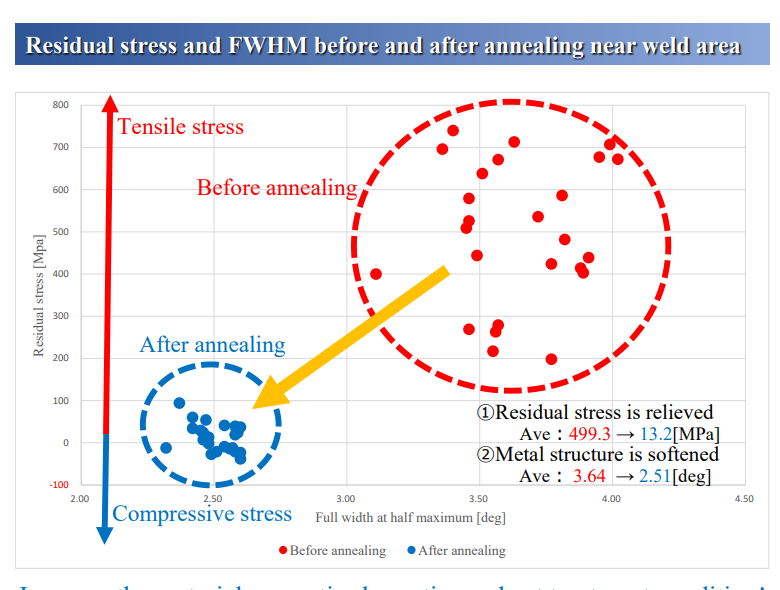
Laser welding generates very steep thermal gradients, and when combined with rapid cooling and solidification, can create high residual stresses.
Our analyzer can generate detailed maps of the stress in a weld, visually showing areas with the highest risk of cracking. When developing a Welding Procedure Specification, our analyzer helps optimize fixturing and determine the best welding method.
Positioning an XRD unit for point-by-point measurement can make mapping a slow activity. However, Pulstec’s Robotic Stress Mapping System combines a 3D scanner with a robotic arm that quickly moves the XRD head between positions to accelerate stress mapping, making it practical for a wide range of welding processes.
Evaluating Grain Size in Additive Manufactured Parts
Using our μ-X360J for non-destructive grain size evaluation helps improve yields in additive manufacturing. Metal-additive processes, especially those using laser fusion, often create very small grains. Smaller grains increase strength, but grain properties are influenced by build direction and tend to be anisotropic.
When XRD (using the cosα method) is performed on additive parts, FWHM measurements provide information on crystallite size, which can then be used to determine expected strength and fatigue-resistance properties. Additionally, residual stress information indicates how distortion problems might arise.
Determining Deterioration in Oil Refining Tanks
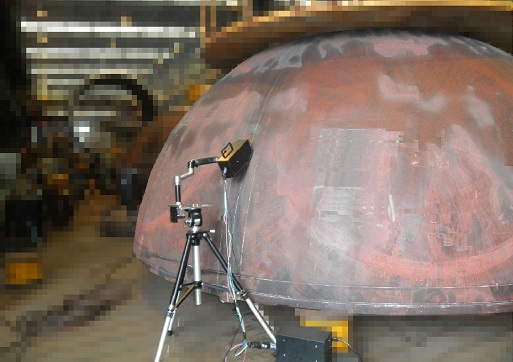
Leaks in oil tanks can be environmentally damaging, costly to repair, and potentially dangerous. XRD, used in conjunction with ultrasonic thickness testing, magnetic flux leakage, and visual inspection, is a valuable tool for detecting problems before they become serious.
Leaks often arise at welds, and a portable XRD system like the μ-X360J is ideal for performing the fast on-site checks needed. Our analyzer can measure residual stress around welds and, when measurements are made over time, identify how stress evolves. It can also identify corrosion compounds, such as iron oxide and sulfides, and reveal lattice distortion as is caused by embrittlement.
Predicting Fatigue in Turbine Blades
Turbine blades are frequently subjected to high temperatures and loads, so they are susceptible to creep and fatigue cracking. Creep shows up as distortion in the crystal lattice and can be seen by comparing XRD measurements taken over time, as diffraction changes with lattice distortion. For these reasons, periodic inspections using XRD equipment help reduce the risk of these potentially catastrophic failures.
Pulstec’s μ-X360J XRD analyzer can also measure residual stress in the blade surface. Ideally, this will be compressive, but accumulated lattice strain can cause it to transition to tensile. This transition raises the total loads experienced, possibly accelerating fatigue cracking and even leading to complete failure.
Using our analyzer, you can perform fast, non-destructive measurements, even in situ.
Managing Maintenance Quality for Bridges
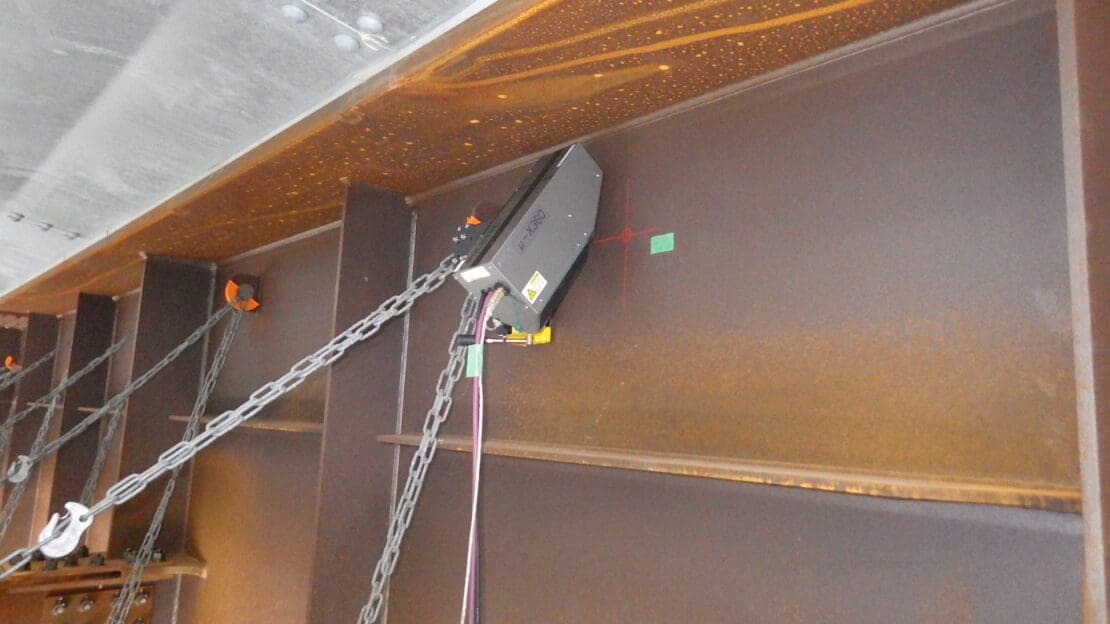
Welding during bridge construction and repair is a situation where residual stress can cause distortion and raise stress levels to undesirable levels. In such cases, a portable XRD system is ideal for performing quick yet repeatable measurements that will indicate the magnitude of the problem.
Pulstec’s XRD analyzer makes this type of field measurement easier to do. The measurement unit is compact and portable, and the integrated LCD monitor makes setting up measurements straightforward. In addition, data from the cosα method can be processed quickly, reducing delays and downtime while ensuring the structure’s safety.
Request a Free Demo
XRD diffraction is a sophisticated, innovative technology, and even those familiar with it aren’t always aware of the benefits of using the cosα method.
If you’re interested in learning more about our μ-X360J XRD analyzer and how it can help improve accuracy and reliability in your testing and inspection applications, contact us today to request a free virtual demo and three complimentary measurements.